

In this article
Everyone keeps talking about AI like it’s a wave you either ride or get flattened by. A bit dramatic, sure, but there’s truth in it. AI has quietly worked its way into hiring, marketing, customer support, even the autocomplete in your email. The people who’ve bothered to learn how these tools actually work are getting ahead faster than the ones ignoring it. That gap is basically what AI training tries to close.
What is AI Training?
Strip away the buzzwords and it’s pretty simple: learning how AI systems function and how to actually use them well in real life. Some people just want to know how to get better answers out of a chatbot. Others want to understand the machinery behind it, maybe even build their own models.
It usually falls into a few buckets:
- Getting the basic concepts down, like what machine learning actually means versus what people assume it means
- Learning specific tools your job already touches, whether that’s a writing assistant or a data platform
- Going technical, meaning code, model training, the works
- Figuring out how to ask AI the right questions so you’re not wasting time on bad outputs
A social media manager doesn’t need the same training as someone building recommendation engines. Match the training to what you’re actually trying to do.
Why Are Companies Suddenly Investing in It?
Money, mostly. A team that knows how to use AI tools gets through work faster and with fewer dumb mistakes slipping through. That’s an easy sell to any manager watching a budget.
But there’s also a nervous energy behind it. Nobody wants to be the company still doing things manually while a competitor cuts turnaround time in half. So training budgets get approved not just because AI is useful, but because falling behind feels risky.
How Can AI Training Help Your Career?
| Benefit | What it looks like in practice |
| Job security | Harder to replace when you’re the one steering the AI, not competing against it |
| Pay | Roles that list AI skills often pay more than nearly identical roles that don’t |
| Speed | Work that used to take hours, like drafting or crunching numbers, shrinks down significantly |
| New roles | Jobs like prompt engineer or automation lead barely existed a few years back |
| Better calls | AI can spot patterns in data that a person would take much longer to notice, if at all |
None of this replaces actual judgment. It just means you’re making decisions with more to work with and less busywork eating your day.
What Skills Should You Focus on First?
Nobody expects you to turn into an engineer overnight. Start small.
- Get decent at prompting. This one skill alone changes how useful every AI tool feels
- Pick one or two platforms that actually matter for your role and go deep on those instead of skimming ten
- Learn where AI messes up, like biased data or confidently wrong answers, so you know when to double check
- Build some comfort with numbers and data, since a lot of this work involves reading trends
- If the technical side interests you, Python is worth a look. Most AI tools run on it in some form
Which Career Paths Benefit the Most?
Some industries are moving faster than others here.
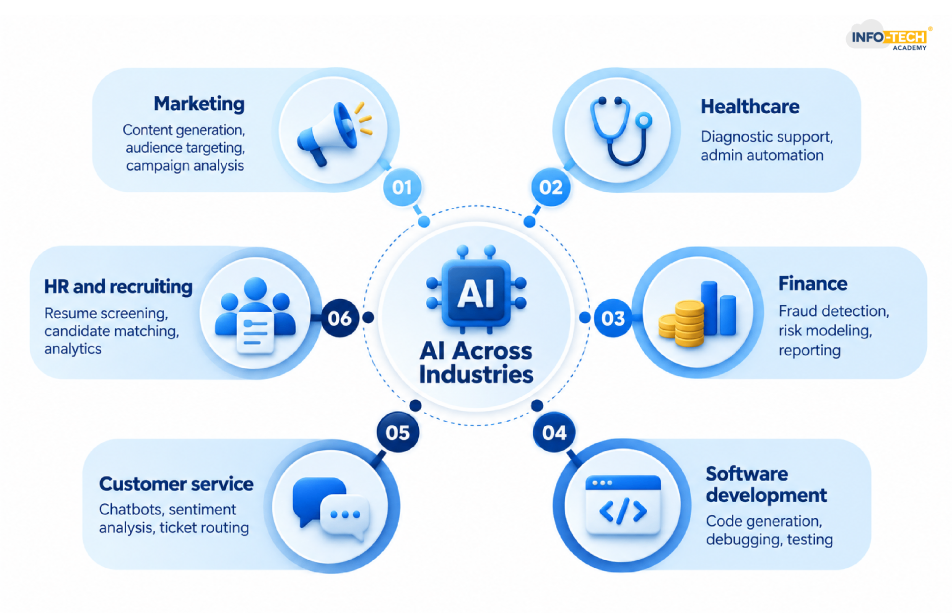
| Field | How AI training shows up |
| Marketing | Writing content, targeting audiences, breaking down campaign data |
| Healthcare | Supporting diagnoses, cutting down admin work |
| Finance | Catching fraud, modeling risk, automating reports |
| Software development | Writing and debugging code, running tests |
| Customer service | Chatbots, reading customer sentiment, sorting tickets |
| HR and recruiting | Screening resumes, matching candidates, tracking employee data |
Even fields that seem far removed from tech, like teaching or logistics, are picking this up quietly. The people already comfortable with AI basics will have a head start when it lands in their department.
How To Get Started?
Forget signing up for some massive program right away. Try this instead:
- Grab one AI tool that fits your job and actually use it every day for a couple weeks
- Take a short course to patch the gaps in your understanding
- Follow a handful of people who actually know this space instead of chasing every headline
- Practice on real work tasks, not made up examples
- Check back on your skills every few months, because this space shifts fast and what worked last year might already feel outdated
Steady effort beats cramming everything in one weekend.
Learning AI isn’t about chasing a tech career you never wanted. It’s about not getting boxed out of the job market as it shifts under everyone’s feet. People who start early tend to land better options and worry less about what’s next. The ones who wait usually end up scrambling later, trying to catch up all at once. Get started on AI course today.
Register NowAI Training FAQs
How do I get trained in AI?
Start by figuring out what you actually need it for, since a marketer and a developer don’t need the same training. From there, pick up the basics through free resources, start using one or two AI tools relevant to your job daily, and take a structured course if you want more depth.
What is the best AI course in Malaysia?
There is no single best AI course for everyone. One of the valuable and reliable AI course is provided by Info-Tech Academy. They provide hands-on learning and in-depth explanation of concepts in a simple and understandable way.
Is it hard to study AI?
Not really. The basics, like understanding what these tools can do and how to use them well, are honestly pretty approachable. Most of it comes down to practice rather than raw intelligence or a math-heavy background.
Can I make money if I learn AI?
Yes, either through better pay in your current job, freelance AI work, or building actual AI skills that open higher paying roles.

Transforming thoughts and concepts into clear, compelling words is a powerful tool that connects people. While writing boosts my creativity, reading broadens my perspective and sharpens my understanding of language and narration.