

In this article
Artificial Intelligence has become an important part of education these days. Both the students and teachers are getting benefitted out of this. Students use an AI to easily understand difficult concepts, learn languages and clear doubts even out of a classroom. Whereas teachers use them to prepare study materials, quizzes and complete administrative works.
In Malaysia, the usage of digital technologies is growing fast, and this creates mew opportunities for students, teachers and other working professionals. With the help of AI, learning has become more interactive, personalised and interesting.
Understanding how AI in education works help the individuals become future ready where technologies will play a crucial part in learning and career development.
What is AI in Education?
AI in education refers to using available AI tools to make learning easier and more convenient for both the students and the teachers. This can give personalised recommendations for learning and help teachers to complete the repetitive tasks sooner, spend more time to teach and interact with the students.
AI can identify the subjects or concepts that students find difficult to learn and provide them personalised recommendations. Teachers can use AI tools to prepare learning materials, quizzes, examples and provide feedback.
AI does not replace teachers completely. Instead, it can help teachers to do their work efficiently and allows children to learn at their own pace.
How is AI Transforming Education in Malaysia?
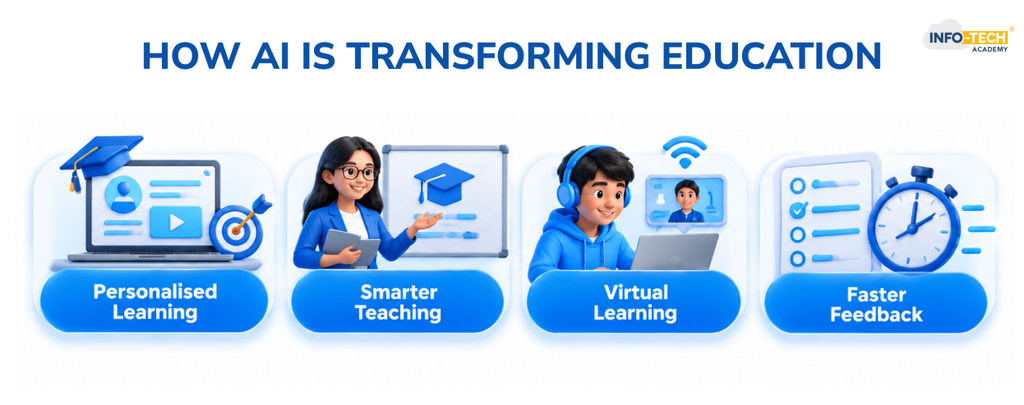
Personalised Learning:
Traditional classroom systems often follow the same teaching approach for all the students. However, every student will have different learning abilities. AI-powered learning will analyse individual performance and recommend learning materials accordingly.
Smarter Teaching Methods:
AI helps teachers reduce the time spent on repetitive tasks and spend more time on teaching. Teachers can use AI tools to prepare learning materials, quizzes and educational contents.
By reducing their time spent on other activities they can interact more with the students and improve the learning experience.
AI-Powered Virtual Learning:
Online education has become crucial for students and professionals in Malaysia. AI-powered virtual learning can pay way for interactive sessions and personalised learning recommendations.
There are also AI chatbots that answer common questions and explain concepts outside their classroom hours. This makes learning easily accessible at any time and helps many students and professionals.
Assessment and Feedback:
Assessing students’ performance is one of the most important parts in education. The AI tools can assist the teachers with this activity by evaluating objective questions and assignments. This saves a lot of time, and the students can get feedback quicker. However, there should be a participation of teachers checking if the evaluation is done right. It is most important to review the assessments, especially for the assignments that require human judgement and creativity in completing them.
What are the Benefits of Using AI in Education?
The learning capability may vary from one person to another. AI helps in providing personalised learning.
Teachers can save a lot of time spent of repetitive and administrative tasks. The time can be better utilized for teaching and have interactive sessions with the students.
Students can get support for their learning apart from their classroom hours.
Automated assessment systems provide feedback to the students quickly. So, they can easily find mistakes and areas of improvements.
They get accessibility to translation and assistive tools. This can help students learn through different methods rather than the traditional learning system.
What are the Challenges of Using AI in Education?
AI is doing wonders in educational field and has a lot of advantages. But also, it is important to note that its adoption comes with certain challenges.
Educational institutions must ensure that the students’ information is protected securely and the AI tools are handled responsibly.
It is not necessary that all the information generated by AI will be right. They can generate inaccurate or hallucinated information. So, the students and teachers must review them before using it.
There are possibilities that students become too dependent on AI tools to complete their assignments. AI tools should be their supporting tools rather than replacing their independent thinking.
Educators may not have proper understanding of how to use the AI responsibly. They should be trained on how to use AI and better integrate them into teaching effectively. Developing smart prompting skills may help them use AI more efficiently and responsibly.
Read Also: AI Content Creation: Tools & Best Practices
What is the Future of AI in Education in Malaysia?
AI is expected to have an important place in education and professional training systems in Malaysia. AI literacy and digital skills became necessary to get better career opportunities in the future. So, the students and professionals should be ready in prior to face them.
By investing in AI course and continuous learning, students and professional become ready to easily adapt for the increasingly AI-driven working environments.
AI in Education – FAQs
How can students use AI responsibly?
The students should be clear about for what they are using an AI. The parents should ensure that independent thinking of children is not destroyed with the usage of AI.
Why AI skills are important for students?
The AI skills can help students adapt to modern technologies and stay prepared for future career opportunities.
What are some AI tools used in education?
AI tools used in education include ChatGPT, Google Gemini, language learning applications, automated assessment tools and content creation tools.
Is AI in education suitable for all age groups?
AI can support learners of different age groups from school students to working professionals. However, the tools should be appropriate as per the learner’s age, educational needs and level of understanding.

Transforming thoughts and concepts into clear, compelling words is a powerful tool that connects people. While writing boosts my creativity, reading broadens my perspective and sharpens my understanding of language and narration.