


In this article
- 1. What’s Actually Worth Learning in AI?
- 2. Can AI Really Teach You a Language, or Just Translate One?
- 3. Is Coding Still Worth Learning if AI Can Write It?
- 4. What Happens to Creativity When AI Can Generate It Too?
- 5. How Do You Keep Your Thinking Sharp When AI Does the Thinking?
- 6. Is Understanding Data Becoming as Basic as Reading and Writing?
- 7. Which Human Skills Are AI Making More Valuable?
- 8. Where to Actually Begin?
- 9. AI Learning FAQs
Something shifted this year. AI stopped being the tool you just open for a quick answer and turned into something closer to a co-teacher, sitting beside you while you actually build a skill instead of just handing you the finished result as such. The real question in 2026 isn’t whether to learn AI or not. It’s what to point it at once you do.
What’s Actually Worth Learning in AI?
Not everything that AI touches is worth learning through it. The sweet spot is anything that is with a feedback loop: languages, code, writing, design, even fitness form, where AI can watch what you work on it by yourself and tell you exactly where it broke down. Skills that used to take a classroom and a patient teacher now just takes a laptop and twenty minutes of your time to learn. If you learn AI as a feedback partner rather than an answer machine, the skills worth chasing become obvious pretty fast.
Can AI Really Teach You a Language, or Just Translate One?
Translation is always the easier part for AI, but teaching is different. It means noticing that you keep mixing up two verb tenses and building the next five exercises around that exact gap. That’s what’s changed.
AI tutors in 2026 don’t simply correct your sentence, they remember your error patterns across weeks and quietly steer you toward what you personally need to develop. It still won’t replace a conversation with a real speaker, but it obviously does shrink the gap between starting and being ready for that conversation.
Is Coding Still Worth Learning if AI Can Write It?
Yes, though not the way it used to be. Typing syntax from memory matters less now; reading code critically, spotting a flawed approach, and knowing what to ask for matter more. The programmers pulling ahead in 2026 treat AI like a fast but occasionally wrong junior developer, someone whose work you can direct, question, and improve. Learning to code today looks more like learning to think in systems, with the typing outsourced.
What Happens to Creativity When AI Can Generate It Too?
This is where people get it backwards. AI doesn’t remove the need for taste, it only exposes it. Anyone can generate a hundred versions of an image or a paragraph in seconds using AI; almost no one can tell which one is actually good, or why. That judgment, knowing what makes a story land, a design feel balanced, a joke work, is now the scarce skill, not the production itself. Learning to create with AI means learning to edit ruthlessly, not just prompt endlessly.
How Do You Keep Your Thinking Sharp When AI Does the Thinking?
You can do it by deliberately doing some of it the hard way. If AI answers every question before you’ve sat with it for even a minute, you lose the muscle that notices when an answer is wrong.
A useful habit this year is forming your own rough opinion first, then checking it against AI’s, not the other way around. The people who stay sharp are treating AI as a second opinion, not a first draft of their own mind.
Is Understanding Data Becoming as Basic as Reading and Writing?
Close to it. Every AI tool spits out numbers, charts, and confident sounding claims, and most of them are only half right without context. Knowing how to question a statistic, spot a misleading graph, or ask “compared to what” is no longer a job for analysts alone. It’s becoming a basic filter for anyone consuming information daily. You don’t need to learn statistics from scratch; you need enough data literacy to not get fooled by a well formatted chart in a confident tone.
Which Human Skills Are AI Making More Valuable?
The ones that resist automation precisely because they depend on being human in the room: negotiation, reading a tense meeting, comforting someone, building trust over time. As AI absorbs more routine cognitive work, the remaining premium sits on judgment under uncertainty and genuine connection.
Oddly enough, the more capable AI gets, the more it rewards people who invest in emotional intelligence and communication, because those are the things it still can’t fake convincingly, no matter what.
Where to Actually Begin?
Pick one skill where you’d benefit from instant feedback, and learn AI specifically for that loop rather than as a general purpose crutch. Give yourself deliberate moments to think before you ask. And keep sharpening the parts of you that judge, connect, and decide, because those are what turn everything AI produces into something actually worth having.
You can always turn to an AI course that teaches you from basics (AI course for beginners) to pretty much everything you need to learn in AI.
Register NowAI Learning FAQs
How can I start learning AI?
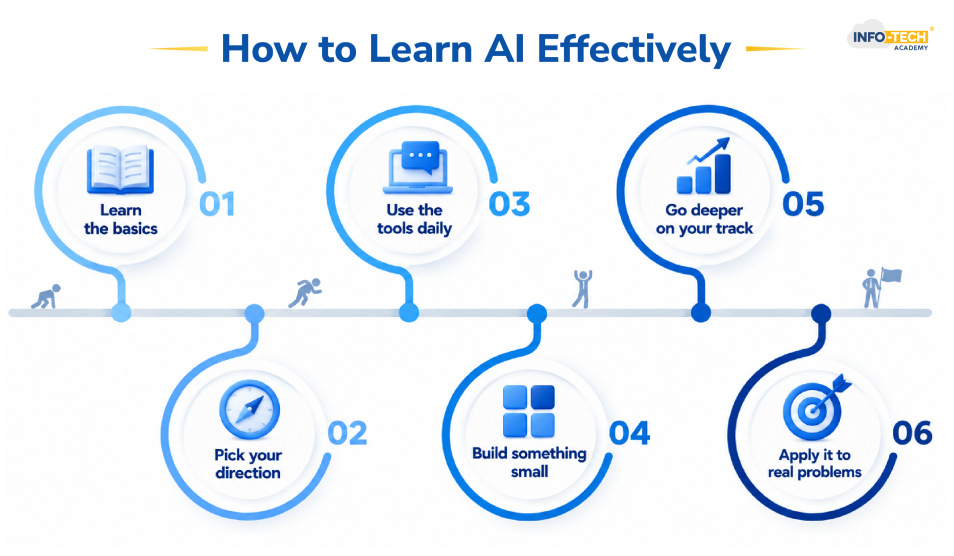
Start using AI tools daily on real tasks while learning the basics of how they work. Then pick a direction (practical use vs. technical), build one small project in it, and keep testing yourself against real problems.
What is the best way to learn AI?
Hands-on practice beats passive learning every time. Reading about AI or watching tutorials builds vocabulary, but actually using tools daily, then building something small with them, is what makes the concepts stick.
What should I start learning in AI?
Start with prompt engineering and just using tools like ChatGPT or Claude well, that alone covers 80% of what most people need in 2026. If you want to go deeper, add Python and basic machine learning concepts (how models are trained, what data literacy looks like) on top of that.
Is AI hard to learn?
No, not if you break it down. Using AI tools well is genuinely easy to pick up, most people get comfortable within days. It only gets hard if you go deep into the technical side (the math behind models, building your own), and even then it’s more “takes time” than “hard.”

Transforming thoughts and concepts into clear, compelling words is a powerful tool that connects people. While writing boosts my creativity, reading broadens my perspective and sharpens my understanding of language and narration.