

In this article
- 1. What is HRD Corp?
- 2. What Does “Claimable Training” Actually Mean?
- 3. Which Employers Need to Register with HRD Corp?
- 4. How Does the Actual Claim Process Work?
- 5. What Are the Different Ways Employers Can Fund Training Through HRD Corp?
- 6. What Should Businesses Keep in Mind For 2026 Specifically?
- 7. Why Does Understanding This Actually Matter?
- 8. HRD Corp Training FAQs
Anyone who has spent time in HR or run a small business in Malaysia has likely bumped into the phrase “HRD Corp training” while sorting out payroll, browsing a training provider’s website, or sitting through a budget meeting. It sounds official, maybe even a little intimidating, but the idea behind it is actually pretty straightforward once you strip away the acronyms.
What is HRD Corp?
HRD Corp is the Human Resource Development Corporation, a government agency operating under Malaysia’s Ministry of Human Resources. Older readers or long-time business owners might know it by its earlier name, HRDF. The two names still get used interchangeably in a lot of conversations even now.
What HRD Corp does, at a practical level, is manage a national fund built from employer contributions. Every month, a small slice of an employee’s wage gets set aside by the employer into this pool. Over time, that pool becomes something the employer can actually use, mainly to fund training for their own staff. So rather than being just another regulatory body checking boxes, HRD Corp functions more like a financial partner that quietly supports workforce development behind the scenes.
What Does “Claimable Training” Actually Mean?
A training program becomes “claimable” when it meets the standards HRD Corp has set, which then allows the cost of that training to be paid, wholly or partially, using the money an employer has already been contributing.
Think of it this way: if a company sends five employees for an AI course and that course happens to be HRD Corp approved. The company isn’t necessarily footing the entire bill from its own operating budget. Instead, it draws from a fund it has been building up all along, almost like a savings account earmarked specifically for staff development. The training still has to be delivered by a trainer or provider that HRD Corp recognizes, since the approval isn’t just about the course content but also about who’s teaching it.
Which Employers Need to Register with HRD Corp?
Not every business in Malaysia is required to register, and this is where a lot of confusion tends to creep in. Companies operating in certain designated sectors, once they cross a certain headcount – around ten Malaysian employees. They are obligated to register and start contributing. Smaller businesses sitting just under that threshold often have the option to register voluntarily if they see value in building up a training fund early.
Once a company registers, it essentially opens the door to accumulating a levy balance. And that balance is what eventually gets tapped into whenever training claims are made later on. Skipping registration means skipping the fund entirely, which is why so many HR departments treat this step as a priority rather than an afterthought.
How Does the Actual Claim Process Work?
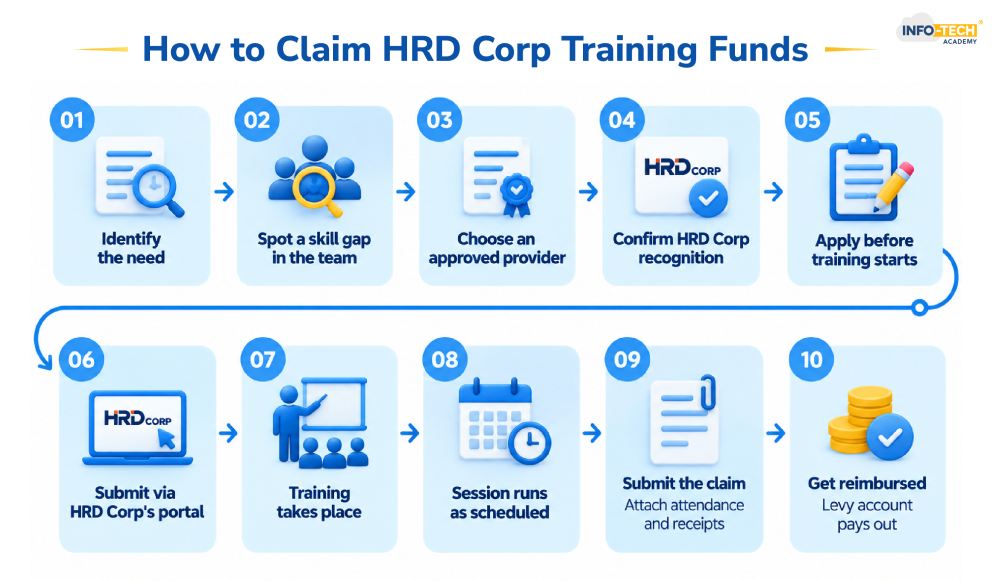
The process itself isn’t overly complicated, though it does require a bit of forward planning. It usually starts with a company recognizing a skill gap or a development need among its staff. From there, someone identifies a training program, ideally one that already qualifies under HRD Corp’s criteria, and submits an application through HRD Corp’s online portal before the training actually takes place.
Assuming approval comes through, the training proceeds as scheduled. Afterward, the employer pulls together supporting documents, things like attendance sheets and payment receipts, and submits a formal claim. HRD Corp then reviews everything before releasing the approved funds from the employer’s levy account. One detail that trips people up often is timing. Claims generally need to be lodged before or very soon after the training happens, not weeks or months down the line, so waiting too long can mean losing out entirely.
What Are the Different Ways Employers Can Fund Training Through HRD Corp?
There isn’t just one rigid path here. Depending on how a company approaches training, whether it’s designing something internally or sending staff to an external open session, different funding schemes come into play. Some are built for employers who want full control over choosing their own trainers and curriculum. Others cater to employees joining scheduled public courses run by outside providers. And there are additional support schemes aimed at smaller businesses or specific industries that might need a bit more flexibility.
Since these schemes do get reviewed and adjusted periodically, it’s genuinely worth checking HRD Corp’s own portal before locking in any plans, rather than relying purely on older information that might no longer reflect current terms.
What Should Businesses Keep in Mind For 2026 Specifically?
A few things are shifting this year that are worth paying attention to. Contribution rates and eligibility rules do get revisited from time to time. Businesses that rely on outdated figures sometimes find their claims rejected simply because the numbers changed without them noticing. There’s also a noticeable push toward training tied to digital skills, workplace safety, and sector-specific upskilling, which reflects where the broader job market seems to be heading.
Beyond the technical details, there’s a subtler shift happening too. More employers are starting to treat their levy contributions as an actual part of their training budget rather than something separate they forget about until claim season arrives. That mindset alone tends to lead to smoother planning throughout the year instead of last-minute scrambling.
Why Does Understanding This Actually Matter?
When a business genuinely understands how the levy and claim system fits together, training stops feeling like an unavoidable expense. It starts feeling more like something the company has already invested in ahead of time. That small shift in perspective often changes how seriously staff development gets taken internally. Teams end up more consistently trained, employees feel more supported in their growth, and the whole organization becomes a bit more adaptable as industry demands keep changing.
Getting familiar with how the system works is really just the starting point. Once that clicks, figuring out which training actually makes sense for a team becomes a much easier decision to make.
HRD Corp Training FAQs
What training can I claim under HRDF?
There isn’t one single list carved in stone. HRD Corp approves a broad mix that includes technical and vocational courses, soft skills and leadership programs, digital skills training like data analytics or cybersecurity, workplace safety and compliance courses, and sector specific upskilling depending on the industry a company operates in.
Is HRD Corp government or private?
HRD Corp is a government body, not a private company. It operates under Malaysia’s Ministry of Human Resources, which is what gives it the authority to manage the national training levy system and approve which courses and providers qualify for claims.
What is HRD claimable?
“HRD claimable” simply describes any training that meets HRD Corp’s approval standards, which means the cost can be paid for, fully or partly, using the levy funds.
Who needs to pay HRDF?
There isn’t a blanket rule for every business. Employers in specific industries covered under the Pembangunan Sumber Manusia Berhad Act generally have to register and contribute once they reach ten or more Malaysian employees, and at that point it becomes a legal obligation rather than a choice.

Transforming thoughts and concepts into clear, compelling words is a powerful tool that connects people. While writing boosts my creativity, reading broadens my perspective and sharpens my understanding of language and narration.